
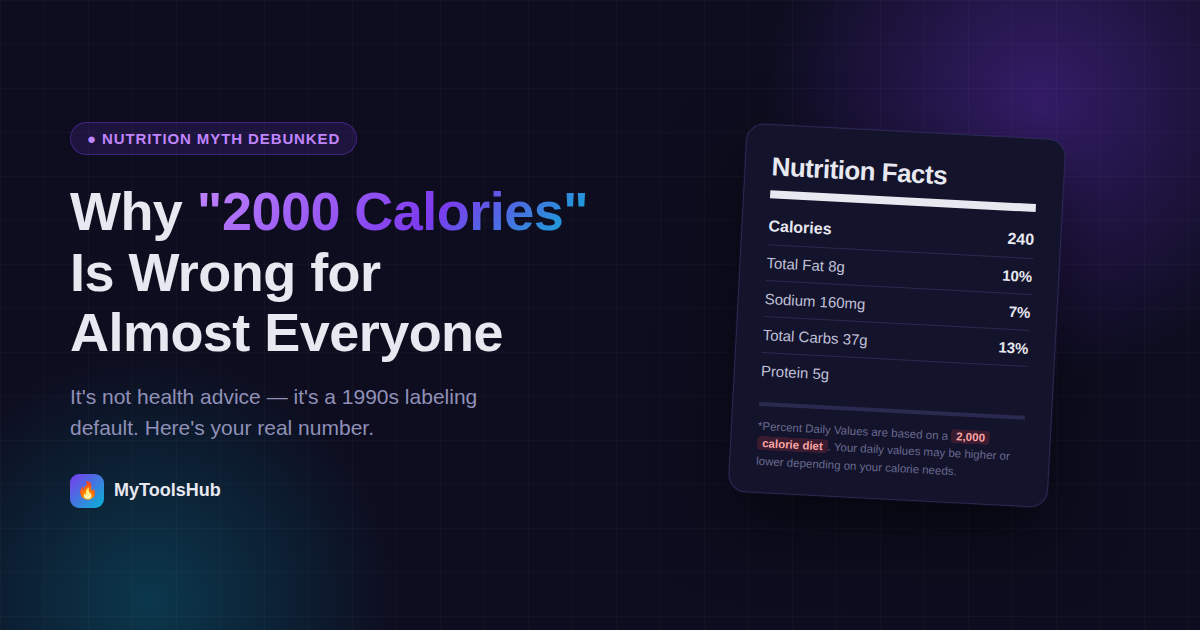
Why "2000 Calories a Day" Is Wrong for Almost Everyone
Flip over almost any packaged food in your kitchen right now and you'll find the same sentence in small print near the bottom of the nutrition label: "Percent Daily Values are based on a 2,000 calorie diet." It's so familiar that most people read straight past it. But that single number has quietly become the default mental benchmark millions of people use to judge whether they're eating "too much" or "too little" — despite the fact that it was never meant to describe any actual person.
This article traces where that number actually came from, why it doesn't apply to most individuals, and walks through the real formula nutrition researchers use to estimate calorie needs — the same one built into our Calorie Calculator.
A Number From a Label, Not From You
The 2,000 calorie figure isn't a medical recommendation. It's a regulatory artifact. When the U.S. Food and Drug Administration designed the Nutrition Facts panel, it needed one fixed reference number so that "% Daily Value" figures could be printed consistently across millions of different food products, regardless of who eventually bought them. Without a shared reference point, percent-daily-value numbers would be meaningless — a label can't print a different percentage for every possible shopper.
So the FDA picked a single value to standardize against, and 2,000 calories was the number that stuck, landing roughly in the middle of typical adult calorie ranges without being precisely tailored to anyone. It functions the same way a "one-size-fits-most" t-shirt does — close enough to be useful as a rough industry standard, not built to fit any one body.
The percentage figures next to sodium, fat, and carbohydrates on every label are calculated against that fixed 2,000 figure — not against your actual calorie target. If your real number is 1,600 or 2,800, every "%DV" on every label you've ever read has been calculated against a number that isn't yours.
How Far Off Is 2000 for an Actual Person?
Government dietary guidelines give a useful starting picture of just how wide the real range is. According to U.S. Dietary Guidelines estimates, adult women typically need somewhere between 1,600 and 2,400 calories a day, while adult men typically need between 2,200 and 3,000 — and that's before accounting for height, age, or how active someone actually is.
Lay those two ranges next to the flat 2,000 figure and the gap becomes obvious:
| Group | Typical Range | Where 2,000 Falls |
|---|---|---|
| Adult women | 1,600 – 2,400 cal/day | Near the upper-middle of the range |
| Adult men | 2,200 – 3,000 cal/day | Below the entire range |
For a smaller, less active woman, 2,000 calories could already be above what her body needs to maintain weight. For an average man, it's frequently several hundred calories under what he actually burns in a day — sometimes close to a thousand short for a larger or more active man. Neither of these people is unusual. They're both well within normal, healthy variation. The label simply wasn't built to flex for either of them.
What Your Body Actually Uses, Piece by Piece
To understand why one flat number can't work for everyone, it helps to break down where your daily calorie burn actually comes from. Researchers split it into a few distinct components:
- Basal Metabolic Rate (BMR): The energy your body burns at complete rest just to keep your organs running, your heart beating, and your body temperature regulated. This typically accounts for 60–75% of total daily calorie burn on its own.
- Activity-driven burn: Everything from formal exercise to walking, fidgeting, and standing throughout the day.
- The thermic effect of food: The energy your body spends just digesting what you eat, a smaller but real contributor.
BMR alone — before you've taken a single step that day — already varies enormously between individuals based on height, weight, age, and sex. Add in wildly different activity levels across different jobs and lifestyles, and a single shared number stops making sense almost immediately.
Why the Number Has Survived Since the Late 1980s
The "2,000 calorie" reference didn't appear overnight. Nutrition labeling in the U.S. has roots going back decades, with the FDA gradually formalizing a standard format as part of the Nutrition Labeling and Education Act. The core problem regulators were solving was consistency, not personalization: if every manufacturer were free to pick their own reference calorie count, percentages on competing products would be meaningless to compare side by side. One brand could show 10% DV for sugar based on an 1,800 calorie reference while another showed 8% DV based on 2,200 calories for the exact same amount of sugar, and shoppers would have no way to know that without doing the math themselves.
Locking the entire system to a single shared number solved that problem cleanly. It just came with a tradeoff nobody put on the label: the number had to be a compromise that didn't precisely describe almost anyone, by design. That tradeoff has quietly persisted for decades because the alternative — printing a personalized label for every possible body type — was never logistically realistic for packaged food at scale.
How Calorie Needs Shift With Age
Even for one specific person, "2,000 calories" stops being a stable target as the decades pass. Basal metabolic rate generally trends downward with age, largely driven by a gradual loss of lean muscle mass, which is more metabolically active than fat tissue. The practical effect is that the same person, eating the same amount and doing the same activity level, tends to need fewer calories at 55 than they did at 25.
| Age Range | General Trend | Primary Driver |
|---|---|---|
| 20s – 30s | Calorie needs near lifetime peak | Higher muscle mass, often more active |
| 40s – 50s | Gradual decline begins | Slow muscle loss, often less incidental activity |
| 60s and beyond | Continued decline, but rate varies widely | Accelerated muscle loss if inactive; resistance training can offset this |
This is part of why a 2,000 calorie target that worked fine for someone at 25 can quietly become a slow surplus by 50, even with no conscious change in eating habits — the body's baseline burn moved, but the habit and the reference number on the label didn't. It's also why the formula-based approach explained above is worth recalculating every few years rather than treating any single number, including your own past TDEE, as permanent.
What Happens When People Eat to the Label Instead of Their Number
The gap between the label default and an individual's real number isn't just a math curiosity — it shows up as a real, common pattern. Someone who is naturally smaller or less active and eats to a 2,000 calorie target month after month, believing it to be a neutral, standard amount, is often running a slow, unintentional surplus without realizing why their weight is gradually trending upward despite "eating normally." On the other end, someone larger or more active who caps themselves at 2,000 calories because it's the number they've always seen on packaging may be under-fueling relative to what their activity level actually demands, which can show up as fatigue, reduced workout performance, or a stalled gym progress that has nothing to do with effort or discipline.
Neither pattern is a failure of willpower. Both are the predictable result of using a regulatory standardization number as if it were individual guidance — a mismatch between what the figure was built for and how it actually gets used by most people reading a label at the grocery store.
The Formula Researchers Actually Use
Instead of a flat number, nutrition science relies on equations that estimate BMR from your individual stats, then scale it up based on activity level to get your Total Daily Energy Expenditure (TDEE) — the number that actually represents your maintenance calories.
The most widely validated of these is the Mifflin-St Jeor equation, developed in 1990 and still considered the gold standard for healthy adults. A 2003 comparison study published in the Journal of the American Dietetic Association found it predicted resting energy expenditure within 10% for 82% of the adults tested — a notably better hit rate than older formulas like Harris-Benedict, which tends to overestimate BMR by 5–15% in sedentary people.
The formula itself is simple enough to do by hand:
Women: BMR = (10 × weight in kg) + (6.25 × height in cm) − (5 × age) − 161
Notice that the only difference between the two versions is the constant at the end — everything else is identical. Once you have BMR, you multiply it by an activity multiplier to get your full daily number:
| Activity Level | Description | Multiplier |
|---|---|---|
| Sedentary | Little to no exercise, desk job | × 1.2 |
| Lightly active | Light exercise 1–3 days/week | × 1.375 |
| Moderately active | Moderate exercise 3–5 days/week | × 1.55 |
| Very active | Hard exercise 6–7 days/week | × 1.725 |
| Extremely active | Physical job plus daily training | × 1.9 |
A Worked Example: Two People, Same Diet Label, Different Reality
To make this concrete, here's how two different people compare against that same flat 2,000 calorie reference, using the formula above:
Person A: Woman, 32, 5'4" (163 cm), 60 kg, lightly active office worker.
BMR = 600 + 1,018.75 − 160 − 161 = 1,297.75
TDEE = 1,297.75 × 1.375 ≈ 1,784 calories/day
Person B: Man, 32, 6'0" (183 cm), 88 kg, moderately active with a physical job.
BMR = 880 + 1,143.75 − 160 + 5 = 1,868.75
TDEE = 1,868.75 × 1.55 ≈ 2,897 calories/day
Person A's real maintenance number sits roughly 216 calories under the label default. Person B's sits nearly 900 calories over it. If both of them used the 2,000 calorie line on a food label as their actual target, Person A would be eating above her maintenance level and Person B would be eating in what amounts to a steep, likely unintentional deficit — over 30% below what his body actually needs. Same label. Same number. Two completely different real-world outcomes.
Why the Formula Still Isn't the Final Word
Even the Mifflin-St Jeor equation, as accurate as it is, produces an estimate, not a guarantee. A few things it can't account for:
- Body composition: The formula uses total body weight, not lean muscle mass. Two people who weigh the same but carry different amounts of muscle will get an identical BMR estimate from this formula, even though their real metabolic rates likely differ.
- Self-reported activity: Most people overestimate how active they actually are, which inflates the final TDEE number if you round up to a more flattering activity level.
- Population averages: The original research behind the formula was based on a specific study population, so individual results, especially at the extremes of body size or age, can vary by roughly plus or minus 10%.
The practical fix researchers and dietitians recommend is to treat the calculated number as a strong starting estimate, then adjust based on real-world results — eat at that target for two to three weeks, track your actual weight trend, and shift the number up or down if your weight isn't behaving the way the math predicted.
A Rough Look-Up Table (Before You Do the Math)
If you want a ballpark sense of where you might fall before calculating your exact number, here's a rough estimate range for a few common combinations, using the Mifflin-St Jeor formula at a lightly-to-moderately active level. Treat these as a starting orientation only — your actual number depends on your specific age, height, and weight, not just the bucket you fall into:
| Profile | Approx. Range |
|---|---|
| Smaller-frame woman, sedentary, 50s–60s | ~1,500 – 1,700 cal/day |
| Average-frame woman, lightly active, 20s–40s | ~1,800 – 2,100 cal/day |
| Larger-frame or active woman, 20s–40s | ~2,100 – 2,400 cal/day |
| Smaller-frame man, sedentary, 50s–60s | ~1,900 – 2,100 cal/day |
| Average-frame man, lightly active, 20s–40s | ~2,300 – 2,600 cal/day |
| Larger-frame or very active man, 20s–40s | ~2,700 – 3,200 cal/day |
Look at where the flat 2,000 figure sits against each of these ranges. It lands below nearly every male category here, and only roughly matches the lower end of the female ranges. That asymmetry is exactly why, in practice, the 2,000 calorie line tends to undershoot real needs for a larger share of the population than it accurately represents — it was never built to be a midpoint between two evenly-distributed groups, just a single workable compromise for label printing.
These ranges are intentionally broad because a look-up table can't account for your specific age, exact height, exact weight, or actual activity pattern the way a calculation can. Once you have a rough sense of your bucket, running your own numbers through the formula — or through a calculator that does the arithmetic for you — gets you a far more precise figure than any table built for general use ever could.
So What Should You Actually Use the 2,000 Number For?
None of this means the 2,000 calorie figure is useless — it's just being used for the wrong purpose by most people who rely on it. Its actual job is narrow: it lets you compare two different packaged products on a level playing field, since every label's percentages are calculated against the same fixed baseline. If one product shows 15% DV for saturated fat and another shows 30%, that comparison is meaningful regardless of your personal calorie target, because both numbers were calculated the same way.
What it was never built to do is tell you, personally, how much to eat. That requires your own height, weight, age, sex, and activity level — the inputs the Mifflin-St Jeor formula actually uses.
Frequently Asked Questions
Where does the 2000 calorie number actually come from?
It comes from FDA nutrition labeling regulations, not from individual health guidance. The FDA needed a single reference value so percent-daily-value figures on packaging would be consistent across products, and 2,000 calories was chosen as that reference point, not as a recommendation for any specific person.
Is 2000 calories too much or too little for me?
It depends entirely on your age, sex, height, weight, and activity level. For some adults, particularly smaller or less active individuals, 2,000 calories is more than maintenance. For others, particularly larger or more active individuals, it's well under maintenance. There's no way to know without calculating your own number.
What formula is most accurate for calculating calorie needs?
The Mifflin-St Jeor equation is generally considered the most accurate widely-used formula for estimating calorie needs in healthy adults, predicting resting energy expenditure within about 10% for the majority of people tested in comparative studies.
Why do two people of the same weight need different calories?
Calorie needs depend on more than weight alone — height, age, sex, muscle mass, and activity level all factor in. Two people at the same weight can have meaningfully different calorie needs if one is taller, younger, or more muscular than the other.
Does the calorie number on food labels change based on who's eating it?
No. The percent daily value shown on nutrition labels is calculated against the fixed 2,000 calorie reference regardless of who is reading the label. It's a standardized comparison tool, not a personalized figure.
It's also worth flagging who this formula-based approach doesn't fully cover. Pregnant and breastfeeding individuals have calorie needs calculated differently, factoring in trimester-specific requirements rather than standard TDEE math. People managing certain medical conditions, recovering from illness or surgery, or working with eating disorder history should get individualized guidance from a doctor or registered dietitian rather than relying on a self-calculated number, formula-based or otherwise. The Mifflin-St Jeor equation was built around and validated against generally healthy adult populations, and it's most reliable when used in that context.
The Takeaway
The 2,000 calorie line on every nutrition label is doing exactly the job it was designed for — standardizing how percentages are printed on packaging — and nothing more. It was never meant to function as personal guidance, and treating it that way means a meaningful share of people are unknowingly eating well above or well below what their body actually needs, simply because the only number they've ever seen is the one printed in small text on the back of a box.
The actual number that matters is the one calculated from your own height, weight, age, sex, and activity level — not the one calculated for a regulatory midpoint that has to apply equally to every shopper in every grocery aisle.
To understand the other side of the equation, you can also check your BMI or explore your healthy weight range alongside your calorie needs.


Comments (0)
Leave a Comment