
How Much Loan Can I Actually Afford? The Monthly Payment Math Explained
Most people approach a loan backwards. They decide how much they want to borrow — say, ₹5 lakhs — then calculate what the monthly payment would be. If it seems manageable, they take the loan. The problem with this approach is that "seems manageable" in the abstract and "actually manageable every month for 3–5 years" are very different things, and the total amount you pay back is almost always significantly higher than what you borrowed.
The smarter approach works in reverse: start with what you can genuinely afford to pay every month, then calculate the maximum loan that amount can support. This article walks through both directions of the math — including the amortization formula most guides skip — and shows you exactly why a longer loan term isn't always the bargain it appears to be.
The Rule of Thumb That Actually Works: The 40% Income Rule
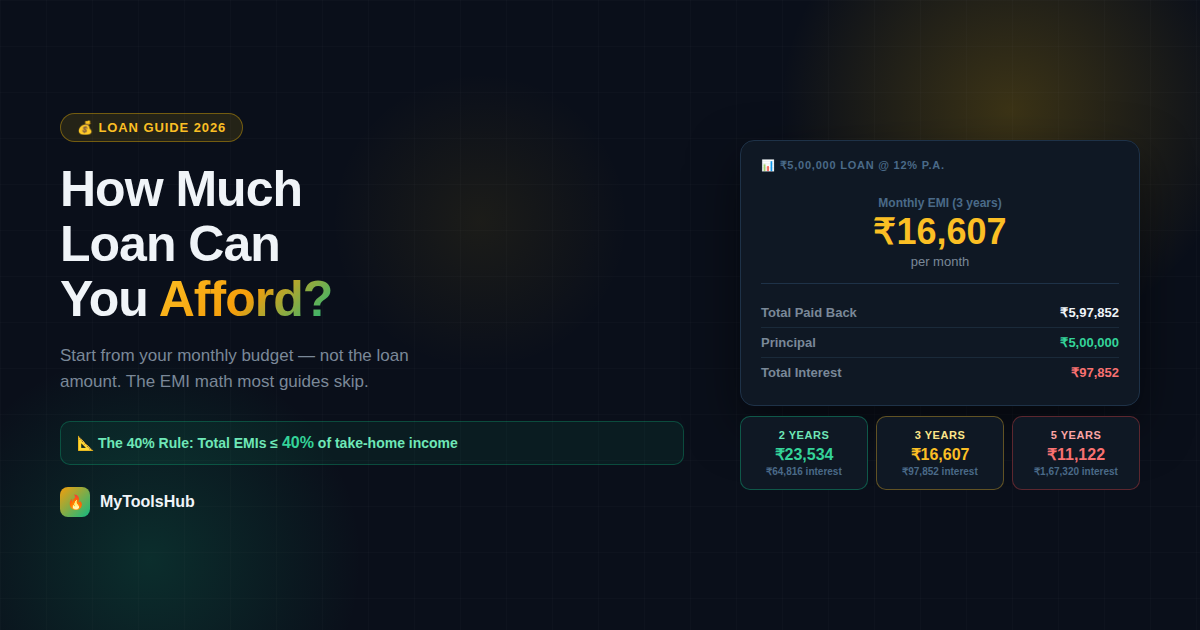
Banks and financial advisors use different affordability thresholds, but one that consistently holds up in practical use is this: your total monthly debt obligations — including the new loan — should not exceed 40% of your monthly take-home income.
This is slightly more conservative than what most lenders will technically approve. Banks often approve borrowers up to 50–55% of income, but at that level, a single unexpected expense — medical bill, car repair, job disruption — can make the payment genuinely unmanageable. The 40% ceiling keeps a buffer.
Monthly take-home income: ₹60,000
Existing EMIs (car loan): ₹8,000/month
Maximum new loan EMI = ₹24,000 − ₹8,000 = ₹16,000/month
This person can afford a new loan with a maximum EMI of ₹16,000 — not whatever loan amount they originally had in mind.
Once you know your maximum affordable EMI, the loan amount and term you can support depends on the interest rate. The next section shows you how to calculate that in both directions.
The EMI Formula — What's Actually Happening in the Calculation
Every loan EMI calculator uses the same underlying formula. Understanding it removes the mystery from why changing the loan term or interest rate affects your payment the way it does.
Where:
P = Principal (loan amount)
r = Monthly interest rate = Annual rate ÷ 12
n = Total number of monthly payments (years × 12)
The formula looks more complex than it is in practice. Here's a worked example at each step:
Loan: ₹3,00,000 | Rate: 12% per annum | Term: 3 years (36 months)
n = 36 months
(1+r)ⁿ = (1.01)³⁶ = 1.4308
EMI = 3,00,000 × 0.01 × 1.4308 ÷ (1.4308 − 1)
EMI = 3,00,000 × 0.014308 ÷ 0.4308
EMI = 4,292 ÷ 0.4308
EMI = ₹9,963/month
Total paid = ₹9,963 × 36 = ₹3,58,668
Total interest = ₹3,58,668 − ₹3,00,000 = ₹58,668
EMI Reference Table — Common Loan Amounts at 12% Annual Interest
Rather than doing this calculation every time, here's a ready reference for common loan amounts at a 12% annual interest rate (a commonly cited benchmark for personal loans in India). The numbers show how dramatically the total interest changes with the loan term:
| Loan Amount | 2-Year EMI | 3-Year EMI | 5-Year EMI | Total Interest (5 yr) |
|---|---|---|---|---|
| ₹1,00,000 | ₹4,707 | ₹3,321 | ₹2,224 | ₹33,440 |
| ₹2,00,000 | ₹9,414 | ₹6,642 | ₹4,448 | ₹66,880 |
| ₹3,00,000 | ₹14,121 | ₹9,963 | ₹6,672 | ₹1,00,320 |
| ₹5,00,000 | ₹23,534 | ₹16,607 | ₹11,122 | ₹1,67,320 |
| ₹10,00,000 | ₹47,073 | ₹33,214 | ₹22,244 | ₹3,34,640 |
The last column is the one most people don't check until after they've signed. On a ₹5 lakh loan over 5 years, you pay back ₹6.67 lakhs total — ₹1.67 lakhs of which is purely interest. That's 33% on top of what you borrowed.
Why Longer Loans Cost You More — The Amortization Trap
The monthly payment is lower on a longer loan, which makes it feel more affordable. But the total interest you pay tells the opposite story. Here's the same ₹5,00,000 loan at 12% across different terms side by side:
| Term | Monthly EMI | Total Paid | Total Interest | Interest as % of Loan |
|---|---|---|---|---|
| 1 year | ₹44,424 | ₹5,33,088 | ₹33,088 | 6.6% |
| 2 years | ₹23,534 | ₹5,64,816 | ₹64,816 | 13.0% |
| 3 years | ₹16,607 | ₹5,97,852 | ₹97,852 | 19.6% |
| 5 years | ₹11,122 | ₹6,67,320 | ₹1,67,320 | 33.5% |
| 7 years | ₹8,664 | ₹7,27,776 | ₹2,27,776 | 45.6% |
This doesn't mean longer terms are always wrong. If the alternative is genuinely struggling to make payments — or defaulting — a longer term is obviously better. The point is to make the choice consciously, knowing what the extended term actually costs in rupees, not just in years.
Why Early Loan Payments Go Mostly to Interest (Not Principal)
This is the fact that shocks most first-time borrowers when they see their first loan statement: despite making a full EMI payment, the outstanding balance barely moved. The reason is amortization — and it's not a trick, it's math.
Interest is calculated on the remaining outstanding balance each month. In month one, you owe the full principal — so the interest charge is at its maximum. As you pay down the principal, the interest charge drops, and a larger portion of each identical EMI goes toward principal reduction.
| Month | EMI | Interest Portion | Principal Portion | Balance After |
|---|---|---|---|---|
| 1 | ₹11,122 | ₹5,000 | ₹6,122 | ₹4,93,878 |
| 2 | ₹11,122 | ₹4,939 | ₹6,183 | ₹4,87,695 |
| 3 | ₹11,122 | ₹4,877 | ₹6,245 | ₹4,81,450 |
| 6 | ₹11,122 | ₹4,688 | ₹6,434 | ₹4,62,437 |
| 12 | ₹11,122 | ₹4,343 | ₹6,779 | ₹4,22,533 |
| 30 | ₹11,122 | ₹2,679 | ₹8,443 | ₹2,56,263 |
| 60 | ₹11,122 | ₹110 | ₹11,012 | ₹0 |
In month 1, ₹5,000 of your ₹11,122 payment — nearly 45% — goes straight to interest. You reduce the loan balance by only ₹6,122. By month 30 (halfway through), the split has shifted — ₹8,443 goes to principal and ₹2,679 to interest. By the final months, almost the entire payment goes to principal. The total EMI never changes, but what it buys shifts continuously.
Working Backward: From Monthly Budget to Loan Amount
Most loan calculators work forward: enter loan amount → get EMI. But the more useful calculation for most borrowers is reverse: enter the EMI you can afford → find the maximum loan amount. Here's how that works:
| Interest Rate | 2-Year Term | 3-Year Term | 5-Year Term |
|---|---|---|---|
| 10% p.a. | ₹2,61,800 | ₹3,68,400 | ₹5,59,600 |
| 12% p.a. | ₹2,55,600 | ₹3,60,000 | ₹5,39,500 |
| 14% p.a. | ₹2,49,500 | ₹3,50,900 | ₹5,20,100 |
| 16% p.a. | ₹2,43,600 | ₹3,41,200 | ₹5,01,600 |
| 18% p.a. | ₹2,37,700 | ₹3,32,200 | ₹4,84,200 |
₹12,000/month budget — how much loan each combination supports at full term.
Notice that a 2% difference in interest rate changes your maximum loan amount by roughly ₹10,000–20,000 at shorter terms, but by ₹40,000–55,000 at 5 years. The effect of interest rate on total affordability is much more significant on longer loans — another reason to keep loan terms as short as your budget allows.
The Interest Rate Nobody Checks: APR vs. Flat Rate
This is where many borrowers get surprised after signing. There are two very different ways lenders quote interest rates:
- Reducing balance rate (APR): Interest is calculated on the remaining outstanding balance each month. As you pay off principal, the interest charge drops. This is what the EMI formula above uses, and what most major banks and NBFCs now quote.
- Flat rate: Interest is calculated on the original loan amount for the entire tenure, regardless of how much you've paid off. A flat rate of 7% is not the same as a reducing balance rate of 7% — it's significantly more expensive. A flat rate of 7% is roughly equivalent to a reducing balance rate of 12.5–13%.
The 40% Rule in Practice — A Complete Affordability Check
Running a complete affordability check takes about two minutes. Here's the full sequence:
- Calculate your take-home income — after tax, after PF deduction, what actually hits your bank account every month.
- Add up all existing EMIs — home loan, car loan, credit card minimum payments, any other installment debt.
- Maximum new EMI = (40% × take-home) − existing EMIs
- Enter that EMI into a loan calculator with the interest rate you've been offered, at your preferred term. The result is the maximum loan amount you can support.
- Check the total interest — if the total amount repaid is significantly more than you expected, consider a shorter term even if it means a smaller loan amount.
One thing this calculation doesn't automatically include: emergencies. A budget that uses 40% of income on debt payments has 60% left for everything else — rent, food, transport, utilities, family expenses. If that 60% is already tightly allocated, the safe ceiling is closer to 30–35%, not 40%. The 40% rule is a ceiling, not a target.
What Changes When You Prepay
Making an extra payment toward the principal — even once — has a disproportionate effect in the early months of a loan, because it reduces the balance that all future interest is calculated on.
On the ₹5,00,000 / 5-year / 12% example from above: making one extra payment of ₹50,000 at month 6 reduces the total interest paid by approximately ₹28,000 and shortens the loan by about 6 months — despite the extra payment itself only being ₹50,000. The leverage is highest early in the loan when the interest-to-principal ratio is most skewed.
Most lenders in India now allow prepayment without penalty on floating-rate personal loans following RBI directions effective January 2026. On fixed-rate loans, some lenders still charge a prepayment fee (typically 2–4% of the prepaid amount) — factor this in when deciding whether prepayment makes financial sense.
Frequently Asked Questions
How much loan can I afford based on my salary?
A reliable rule is that your total monthly debt payments should not exceed 40% of your monthly take-home income. Subtract existing EMIs from that figure to find the maximum new loan payment. Then use a loan calculator to find the loan amount that payment supports at the offered rate and your preferred term.
Why does a longer loan term cost more even though the monthly payment is lower?
Because interest accrues on the outstanding balance every month for a longer period. On a ₹5 lakh loan at 12%, a 2-year term costs about ₹65,000 in total interest. The same loan over 5 years costs about ₹1,67,000 in total interest — more than 2.5x more, despite the monthly payment being lower.
What is the EMI formula?
EMI = P × r × (1+r)ⁿ ÷ [(1+r)ⁿ − 1], where P is the principal, r is the monthly interest rate (annual rate ÷ 12), and n is the number of monthly payments. For a ₹3,00,000 loan at 12% for 3 years: r = 0.01, n = 36, EMI ≈ ₹9,963/month.
Why do early loan payments go mostly to interest?
Because interest is charged on the remaining outstanding balance, which is highest at the start. In month one of a 5-year loan, about 45% of your EMI goes to interest. By the final months, nearly the entire payment goes to principal. The total EMI stays constant, but what it buys shifts continuously throughout the loan.
What is the difference between flat rate and reducing balance rate?
Flat rate interest is calculated on the original loan amount for the entire tenure. Reducing balance rate is calculated on the remaining outstanding balance each month. A flat rate of 7% is roughly equivalent to a reducing balance rate of 12.5–13%. Always ask for the EMI in rupees when comparing loans — the rate alone can be misleading if the method differs.
To calculate your exact EMI, total interest, and full amortization schedule for any loan amount, rate, and term, use our free Loan Calculator. For a broader picture of your financial and physical health, you can also check your BMI or estimate your daily calorie needs — financial planning and health planning often go hand in hand.

Comments (0)
Leave a Comment